
East Valley Movers Prep: Protecting Your Belongings from Mesa Monsoon Rains
I. The “Oh No, It’s Raining”
It starts with the silence. You know the kind.
It’s 2:00 PM in Mesa. The asphalt is radiating that wavy, 110-degree heat. The sun is relentless. Then, almost instantly, the light shifts. The horizon turns a bruised, angry purple. The wind picks up—smelling of ozone and wet creosote—and suddenly, the heavens just… let go.
Welcome to monsoon season.
Let’s be real for a second. Moving is already stressful. It’s a top-tier life stressor, right up there with changing jobs or a root canal, but trying to coordinate a move during an Arizona summer? That’s playing on hard mode. Add a flash flood to the mix, and it feels like the universe is personally pranking you.
One minute you’re worried about heat stroke; the next, you’re terrified your vintage velvet armchair is going to turn into a sponge. It’s chaotic.
Honestly? It’s enough to make you want to cancel the whole thing and stay put.
But don’t panic. Not yet.
While we can’t control the weather (unfortunately), we can control how we react to it. Experienced East Valley movers know this rhythm by heart. We know that these storms are usually furious but fast. We know when to hustle and when to hunker down. However, keeping your belongings dry requires a bit of teamwork and a solid strategy before the truck even pulls up.
Here is how we beat the storm without losing your mind—or your furniture.
II. The Packing Phase: Waterproofing 101
Physics is mean. Especially when water meets paper.
If you take nothing else from this post, remember this: Cardboard is a sponge.
It doesn’t just get wet; it disintegrates. We’ve all seen it happen. You lift a damp box, the bottom gives way like wet tissue paper, and suddenly your collection of vintage Pyrex is shattering on the driveway. It’s heartbreaking. And honestly? It’s completely avoidable.
When the forecast hints at a monsoon, you have to pack defensively.
Ditch the Cardboard (Where You Can)
For the stuff that absolutely cannot get wet—think family photos, tax returns, or that expensive gaming PC—skip the boxes entirely. Use plastic bins. The heavy-duty ones with the snap-lock lids. They are virtually waterproof and stackable.
The “H-Tape” Defense
Okay, realistically, you can’t pack a four-bedroom house in Tupperware. You’re going to use boxes. But don’t just slap one piece of tape down the middle and call it a day. That’s rookie stuff.
Use the H-Tape method:
- Seal the Center: Run your tape down the main seam. Standard.
- Seal the Edges: This is the secret sauce. Tape the side seams where the flaps meet the box edge.
- Repeat: Do this on the top and the bottom.
You’re essentially sealing the box against moisture intrusion. It’s not a submarine—don’t throw it in a pool—but it’ll buy you critical time if you get caught in a downpour between the front door and the truck.
The “Plastic Wrap” Technique
Professional East Valley movers use industrial-grade stretch wrap for a reason. And it’s not just to keep drawers from flying open on the Loop 202.
Think of stretch wrap as a custom-fitted raincoat for your furniture.
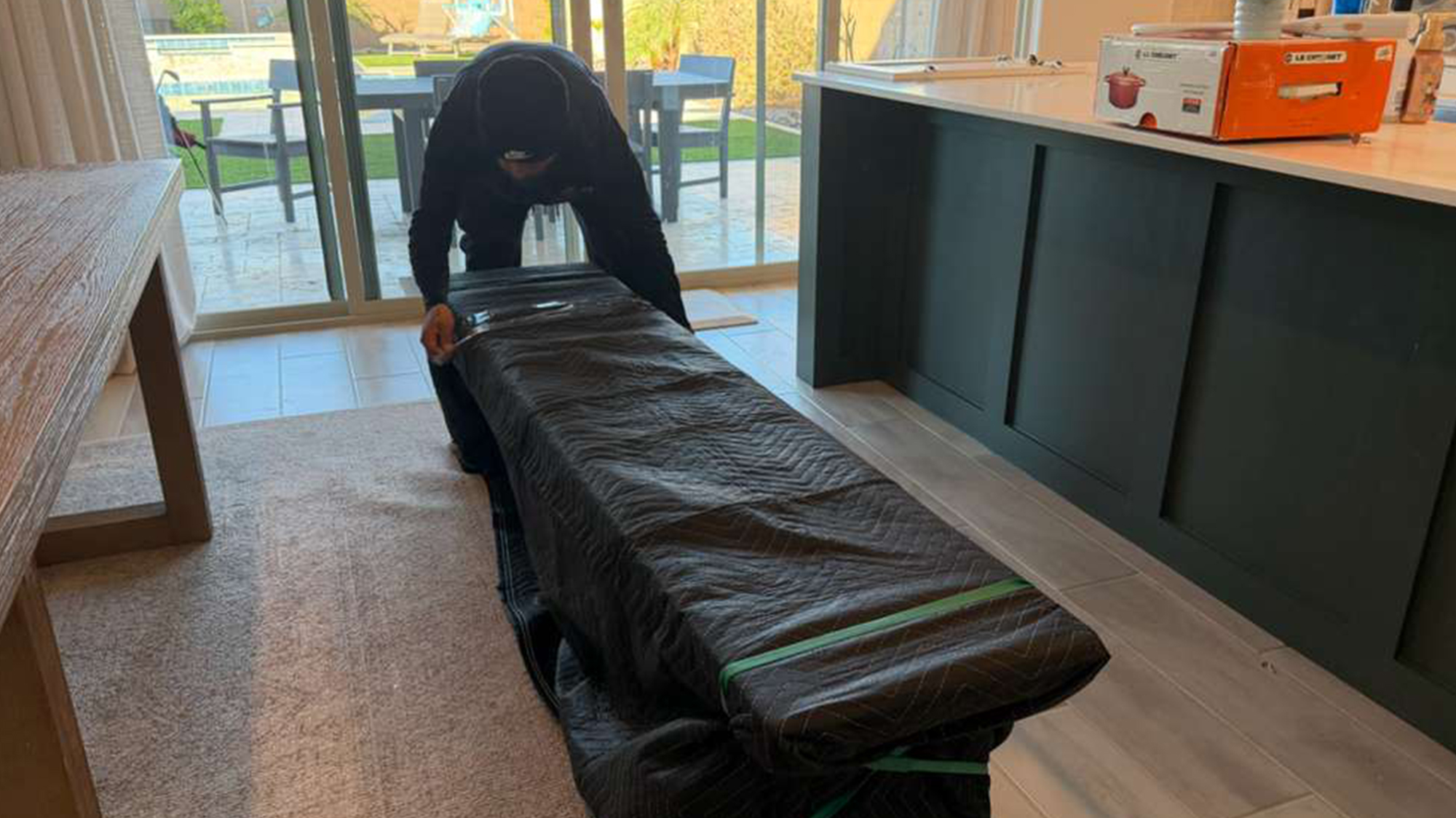
- Wood & Upholstery: Wrap your dressers, nightstands, and sofas. Go heavy on the layers. If the rain starts blowing sideways (and it will), that plastic barrier sheds water instantly, protecting the finish and fabric underneath.
- Artwork: Bubble wrap first, then shrink wrap. Seal it tight.
The Golden Rule: Mattress Bags
Finally, a personal plea from us to you: Buy a mattress bag.
Please.
Mattresses are essentially giant, expensive sponges. If a Queen-size memory foam mattress gets soaked, it doesn’t just dry out. It gets heavy, it smells, and it grows mold. Fast. Spend the $15 on a heavy-duty plastic cover and tape it shut. You’ll sleep better. Literally.
III. Loading Day Strategies (When the Sky Turns Grey)
You know the drill. You’re halfway through loading the living room, and suddenly the sky over the Superstitions turns that ominous, slate grey. You can smell the rain—that thick, dusty scent of ozone and wet asphalt.
Panic mode? No. Strategy mode.
When the clouds roll in, the rules of moving change instantly. Speed matters, but traction matters more. Here is how to manage the chaos when the weather turns against you.
- The Pathway Patrol (Don’t Break an Ankle)
Let’s be blunt: A metal moving ramp combined with rainwater is essentially a slip-and-slide. A dangerous one.
Slippery ramps + heavy boxes = bad news.
Before the first drop hits, designate someone to be on “Pathway Patrol.”
- Inside: Sacrifice your old towels. Lay them down in the entryway and hallways. You are going to track in mud—it’s inevitable—but you don’t need to grind it into the carpet.
- Outside: Never put cardboard on the ramp or the driveway. As we discussed, wet cardboard turns into pulp. It becomes a slipping hazard, not a grip aid. Stick to textured rubber mats if you have them, or just move slower. Much slower.
- The “Gap” Strategy
The goal is simple: Reduce the exposure time. You want to minimize the distance between your front door and the truck’s loading ramp.
If you are renting a truck, back it up until you are uncomfortably close to the garage or porch. Then back it up another foot.
- Human Note: Honestly? This is where hiring pros pays off. Experienced East Valley movers can back a 26-foot truck into a driveway with surgical precision, leaving maybe inches of gap. That means your sofa spends 2 seconds in the rain instead of 20.
- Triage Your Inventory (Wood vs. Plastic)
If the radar says the storm is 15 minutes out, stop loading the random garage boxes. Shift gears.
Prioritize the Vulnerables.
Get the antique dresser, the dining table, and the fabric headboard on the truck now. These items act like sponges. If they get soaked, the wood swells, and the fabric stains. Get them deep into the truck and covered with pads.
The “Rain Squad”
Once the downpour actually starts, switch to the plastic bins and the “H-taped” boxes we talked about earlier. If a plastic tote gets rained on during the sprint to the truck? Who cares. Wipe it off. But if you leave that mahogany desk on the curb while you wait for the ramp to clear?
Disaster.
IV. Why Local Knowledge Matters
Here’s a fun fact about Arizona weather: It lies.
Your weather app might say “Sunny” while you’re staring at a wall of dust a mile high barreling down McQueen Road. That’s the reality of the East Valley.
The microclimates here are wild, and if you aren’t from around here, they can catch you completely off guard.
Predicting the Unpredictable (It’s Not Just Rain)
Before the rain hits, we usually get the haboob.
For the uninitiated, that’s a massive, apocalyptic dust storm that turns the sky orange and drops visibility to zero. If you have a truck ramp extended when a haboob hits, you aren’t just getting dust in your eyes; you’re getting grit embedded into every fiber of your sofa.
This is why hiring specific East Valley movers is crucial.
A national chain or a generic “guy with a truck” might try to power through. They’re on a clock. They don’t know that the wind shift means trouble.
Locals? We know the signs. We know that when the palm trees start bending that way, we have about five minutes to close the truck door and take cover.
The “Wait It Out” Rule
The beauty of a monsoon storm is its speed. It’s violent, loud, and intense—but usually short.
Sometimes, the smartest move is to literally stop moving.
If the skies open up, we don’t force it. We pause. We shut the truck, grab a water, and wait. Usually, 20 minutes later, the sun pops back out, the steam starts rising off the pavement, and we get back to work.
Trying to fight a monsoon is a losing battle. Knowing when to surrender for twenty minutes? That’s just smart logistics.
V. Post-Move Check: The “Dry Out” Phase
The truck is finally empty. You’re exhausted—honestly, you’re probably running on nothing but lukewarm caffeine and pure spite at this point.
But wait. Before you collapse onto your (hopefully dry) sofa, you need to do a quick triage. The move isn’t actually over until you’ve accounted for the moisture.
Unpack the “Clammy” Boxes Immediately
If any of your cardboard boxes feel even slightly soft or damp, do not let them sit overnight.
Damp cardboard is a ticking time bomb. In the humid aftermath of a Mesa storm, a wet box becomes a Petri dish. If you leave your linens or books in a damp box in a warm garage, you’re essentially inviting mold to move in.
- The Rule: If it’s wet, open it. Spread the contents out under a ceiling fan.
- The Reality Check: It’s a perfunctory task that feels like a chore, but it saves you from the “musty basement” smell that is nearly impossible to get out of fabric.
The Electronics Trap (Condensation)
This is the one that catches people off guard. Even if your TV didn’t get “rained on,” the sudden shift from a humid driveway to a cool, air-conditioned living room causes condensation.
Think about a cold soda can on a porch. That same moisture can form inside your PC or television.
Don’t plug them in. Not yet.
Let your electronics acclimate to the indoor temperature for at least an hour or two. Plugging in a “sweating” motherboard is a great way to short-circuit your expensive gear. Just give it a minute.
VI. Conclusion: Stay Dry, Stay Sane
Arizona monsoons are a lot of things. They are intense. They are loud. And if you’re standing in your driveway holding a box of books while the sky turns purple, they can be terrifying.
But they don’t have to be a disaster.
With the right gear (plastic wrap is your best friend), a solid game plan, and a little bit of patience, you can navigate the storm. It’s mostly about respect—respecting the weather enough to pause when you need to, and respecting your belongings enough to pack them properly.
The Bottom Line?
You can do this yourself. But the real question is: Do you want to?
Moving is already a high-wire act. Doing it while dodging lightning bolts and localized flooding is just showing off. Don’t gamble with your grandmother’s antique dresser or that leather sectional you just paid off. It’s not worth the risk of a soggy cardboard nightmare.
Sometimes, the smartest move is to call in the reinforcements.
You need East Valley movers who have seen it all before. Crews who don’t flinch at a haboob and know exactly how to waterproof a piano in under three minutes.
Ready to Move Without the Stress?
Don’t let the weather dictate your schedule. Contact Gilbert Moving and Storage today. We track the storms, we bring the heavy-duty supplies, and we ensure your life arrives at your new home exactly the way it left—dry, safe, and ready for a fresh start.
Let us handle the heavy lifting (and the weather). You just worry about which box has the coffee maker.

